
One of the questions we are most often asked in our work is the possibility of separating the activities and assets that are unified within the same company with the aim, on the one hand, of minimising risks and protecting the different business activities and business assets and, on the other hand and in the vast majority of cases, with the aim of dividing those companies among the different shareholders, either because there are disagreements or conflicts between them or simply because they want a different future for the company.
For this reason, one of the options considered for carrying out this separation is a demerger of the company. At Merac, as lawyers in Málaga, we tell you everything you need to know
-
Spanish regulations
As we have already discussed in previous articles, a demerger is an operation by which all or part of the assets of a company are divided in order to transferwithout liquidation, the resulting share to other pre-existing companies or companies created for this purpose.
The demerger operation, as indicated in previous posts, has a very beneficial tax regime (Special tax regime for mergers, demergers, contributions of assets and share exchanges "FEAC" - Chapter VII of Title VII of the Corporate Income Tax Law), which requires for its application, among other requirements, thatwhich the demerger operation be carried out for a valid economic reason and not simply for the purpose of tax fraud or evasion.
However, several types of demerger must be distinguished under commercial and tax regulations. If you are not clear about the types of demergers, you can always rely on a tax advisor lawyer to solve your problems.
-
A) TOTAL DEMERGER
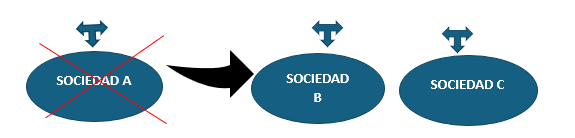
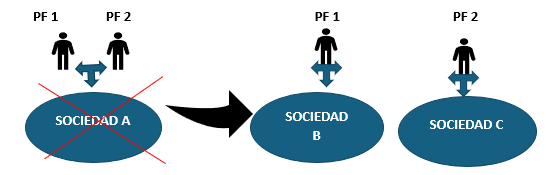
Thus, the total division operation may mean that all the shareholders of the pre-existing company become shareholders in each and every one of the beneficiary companies (maintaining proportionality), both in qualitative and quantitative terms; this may be altered if some shareholders choose to participate in only one of the beneficiary entities, which implies a lack of qualitative proportionality.
However, in the latter case, when the allocation to the shareholders in the beneficiary companies is not proportional to their holding in the demerged company, which is known as a total subjective demerger, article 76.2.2 of the Corporate Income Tax Law requires that, in addition to there being a valid economic reason, the assets transferred to the beneficiary companies constitute lines of business.
The diagram representing the partial demerger operation is as follows:
- Total non-subjective demerger:

- Total subjective demerger
-
B) PARTIAL DEMERGER
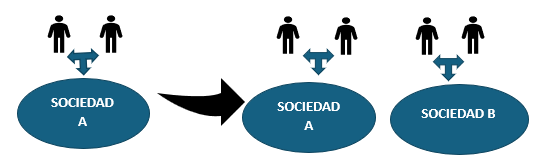
A partial demerger, on the other hand, occurs when the demerged company is not dissolved and divides its assets into two or more parts, provided that they constitute lines of business, with one of them remaining in the demerged company and the other part of the assets being contributed to an existing or newly created company.
Also in this case all the shareholders of the pre-existing company become shareholders in each and every one of the beneficiary companies (maintaining qualitative and quantitative proportionality)
The diagram of the partial demerger operation is as follows:
- Partial demerger
-
European regulation of intra-Community restructuring operations
For its part, the European regulation governing the common tax system applicable to intra-Community restructuring operations (Council Directive 2009/133/EC) establishes in article 2 that a demerger means: "An operation whereby a company, on being dissolved without going into liquidation, transfers all its assets and liabilities to two or more existing or new companies, in exchange for the pro rata issue to its shareholders of securities representing the capital of the companies receiving the assets and liabilities, and, if applicable, a cash payment not exceeding 10% of the nominal value or, in the absence of a nominal value, of the accounting par value of those securities."
As can be deduced from the wording of the Directive, European regulations do not require, for the application of the tax neutrality regime in total subjective demergers, that the assets into which the demerged company is divided constitute a line of business, so it seems that Spanish regulations impose an additional requirement that would prevent us from finding a solution to the question initially raised, in which the shares are to be allocated non-proportionally, so that each shareholder can be allocated shares in only some of the beneficiary entities.
Therefore, the Spanish regulatory requirement for the existence of a line of business makes it difficult to apply the tax neutrality regime to demerger operations that are not qualitatively proportional, in which, despite there being a more than valid economic reason to justify the operation, there are no distinct, differentiated lines of business. A requirement that seems to go completely against the intention of the aforementioned European Directive.
This discrepancy between Spanish regulations and the European Directive is expected to be resolved soon, since the European Commission issued a press release dated 23 May 2024 announcing that it has decided to refer the Kingdom of Spain to the Court of Justice of the European Union (CJEU) for failing to ensure the correct application of the Directive, considering that the requirement for the existence of lines of business, which our regulations establish for the special regime to apply to total demergers that do not respect proportionality, goes against the provisions of Directive 90/434/EEC.
-
Recent court rulings
In addition, it seems that our Courts have begun to anticipate the foreseeable Opinion of the European Commission, as evidenced by the recent Judgment of the High Court of Justice of Castilla y León of 13 June 2023, which analyses the application of the tax neutrality regime to a total demerger in which the assets of the demerged company are distributed among two or more beneficiary companies, but in which the shareholders of the demerged company do not participate in all the beneficiary companies, only in one or some of them.
In the case analysed by the High Court of Castilla y León, the demerged entity did not have several lines of business, as it was exclusively engaged in property leasing. As a result of the demerger, the two beneficiary companies continued to carry out the same activity with the properties received and, for their part, the shareholders of the demerged entity did not receive shares in both beneficiary entities; instead, depending on the family group to which they belonged, they were allocated shares in only one of them. The reason given for this was the disagreements and discrepancies between the family groups.
Initially, the Tax Inspectorate denied the application of the tax neutrality regime, which is why the appellant appealed to the High Court of Justice, which ruled in favour of the appellant, arguing that the provisions of article 76.2.2 of the Corporate Income Tax Law are contrary to European regulations and, in this regard, states that Community regulations only require that demerger operations meet the requirement of quantitative proportionality, i.e. that the economic value of the holding before and after the demerger is the same for the shareholders, regardless of the companies in which they participate, but they do not require qualitative proportionality, that is, that all shareholders participate in all the beneficiary entities.
It should also be noted that the Supreme Court, by Order of 10 April 2024, has admitted for consideration an appeal in cassation that raises, among other issues, whether the requirement to have differentiated lines of business in total subjective demergers is in accordance with Directive 2009/133/EC on the common system of taxation applicable to mergers, divisions, transfers of assets and exchanges of shares.
Therefore, pending how the Supreme Court resolves this issue, it seems that, in view of the above, it will be necessary to amend the FEAC Regime in the current wording of Spanish regulations to accommodate total subjective demergers when the demerged company does not have distinct lines of business. However, we will have to wait and see how this issue is resolved and how it is specifically applied in our legal system, to see whether it will finally be possible to apply the tax neutrality regime to total subjective demergers, which would greatly help the tax and commercial planning of numerous business group restructuring processes.