
On 21 December 2024, Law 7/2024, of 20 December, was published in the Official State Gazette (BOE), bringing with it numerous tax changes, some with effect for tax periods beginning on 1 January 2024.
Below we set out the main new developments of interest in the tax field resulting from this Law.
1. MEASURES AFFECTING CORPORATE INCOME TAX (CIT)
1.1 REDUCTION OF TAX RATES FOR MICRO-ENTERPRISES AND SMALL COMPANIES (ERD)
With effectfrom 1 January 2025 a progressive reduction of the tax rates applicable to companies with lower turnover, such as micro-enterprises and ERDs, is established.
- See reduces progressively the tax rate for micro-enterprises (turnover of less than 1,000,000 euros in the previous period). Until 2024 the applicable rate was 23%, and from 2025 the following scale would apply:
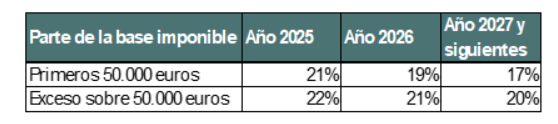
- Tax rates are also reduced for small companies (ERD – those that can apply the incentives of article 101 et seq. of the CIT Law and whose group has a turnover of less than 10 million euros). Until 2024 the applicable rate was 25%, and from 2025 it will be progressively reduced by 1% per year until 2029:

1.2. MINIMUM TAXATION FOR MICRO-ENTERPRISES AND ERDs UNDER THE TAX CONSOLIDATION REGIME
As a result of the above amendment, the minimum taxation rule is adapted to the new rates approved for micro-enterprises and ERDs, so that the minimum instalment payment will be calculated by applying fifteen twenty-fifths (15/25) to the corresponding tax rate (rounded up).
It should be remembered that the minimum net tax liability is a measure applicable since 1 January 2022, which requires companies with a turnover of more than 20 million in the previous 12 months, or those forming part of a tax consolidation group, to pay tax on at least 15% of the tax base, reduced or increased, where applicable, by the levelling reserve and the Canary Islands investment reserve (RIC).
1.3. CAPITALISATION RESERVE
Important improvements to the capitalisation reserve regime are introduced with effect for tax periods beginning on or after 1 January 2025.
It should be remembered that the capitalisation reserve is a tax incentive that seeks to encourage companies' self-financing by allowing them to reduce their tax base by a percentage of the increase in equity achieved, provided that certain requirements are met, including (i) maintaining that increase in equity for at least 3 years (except in the event of accounting losses) and (ii) setting up a restricted reserve for the amount of the reduction applied, which must be maintained for the same period of time.
The approved improvements relate to:
- Increase in the general reduction percentage: Companies companies may reduce the preliminary tax base by the amount resulting from applying 20% to the increase in equity as a general rule (previously this reduction only allowed 10%). This percentage may be increased up to 30% when certain requirements linked to an increase in the average workforce are met.
- Increase in the maximum limits of reduction on the preliminary positive tax base, these being the following:
- Micro-enterprises, increased from 10% to 25% of the preliminary tax base (before offsetting tax losses)
- Other companies, increased from 10% to 20% of that preliminary tax base.
1.4. OFFSETTING OF TAX LOSSES (BIN)
The Constitutional Court judgment of 18 January 2024 annulled some of the tax measures introduced at the time by Royal Decree-Law 3/2016, of 20 December, including the limitation on offsetting tax losses for companies with a turnover of more than 20 million euros.
Law 7/2024 reintroduces some of these measures with effect for tax periods beginning on or after 1 January 2024 (and that had not ended when the Law came into force):
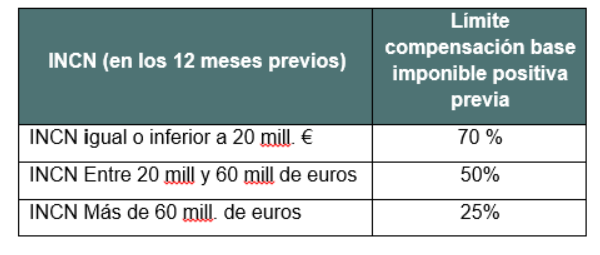
- Limits on the offsetting of Tax Losses (BIN) for large companies, depending on their net turnover (INCN). The limits applicable from 1 January 2024 are as follows:
- Specific limitation on the application of double taxation deductions, both domestic and international, affecting taxpayers with a net turnover of 20 million euros or more in the previous 12 months. This limitation will be 50% of the taxpayer's gross tax liability.
1.5. LIMITATION ON OFFSETTING TAX LOSSES IN TAX GROUPS
See extends to 2024 and 2025 the measure that applied in 2023 under which tax groups are limited to using 50% of the individual tax losses generated in the same year to determine the tax group's tax base.
It should be remembered that the tax base not applied in the year due to this limitation must be reversed in equal parts in each of the ten years following its application. And, in the event of loss of the tax consolidation regime or dissolution of the group, the tax losses pending incorporation must be included in the individual tax base of the entities that formed part of the group.
1.6. REVERSAL OF PORTFOLIO IMPAIRMENTS
The rule on mandatory reversal of impairment losses on equity securities that were tax deductible before 2013 is reinstated.
This measure, which was initially introduced by RDL 3/2016, and which was subsequently declared unconstitutional, is reintroduced for tax periods beginning on or after 1 January 2024, although under the current wording it must be included at a minimum of one third in each of the 3 tax periods following the one beginning on or after 1 January 2024, whereas under the previous wording it had to be included in fifths.
However, the positive income from this mandatory reversal may be offset against tax losses generated in years prior to 2021, applying only the general limit of 70% of the positive tax base prior to offsetting.
2. MEASURES AFFECTING PERSONAL INCOME TAX (IRPF)
2.1. INCREASE IN THE RATE ON THE SAVINGS BASE
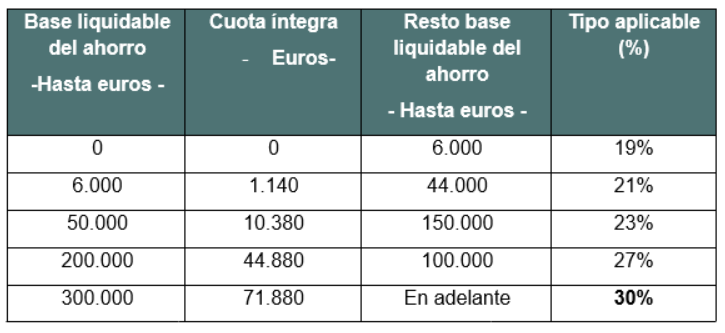
With effect from 1 January 2025, the last bracket of the savings tax scale is amended from 28% to 30%.
This amendment also applies to taxpayers who benefit from the special regime for workers posted to Spanish territory, known as the "Beckham Law".
Taking into account the sum of the state and regional scales, the summary table would be as follows:
2.2. NEW REDUCTION FOR INCOME FROM ARTISTIC ACTIVITIES OBTAINED EXCEPTIONALLY
From 1 January 2025, a 30% reduction is established on employment or business income arising from certain literary and artistic activities, provided that certain requirements are met.
2.3. PERSONAL INCOME TAX REFUNDS FOR MUTUAL SOCIETY MEMBERS
In the last Personal Income Tax campaign, the Spanish Tax Agency set up an electronic form to request the rectification of Personal Income Tax returns for the periods 2019 to 2022 in which the Second Transitional Provision of the Personal Income Tax Law had not been applied. This provision allows a reduction to be applied when retirement or disability pensions are received by mutual society members whose contributions could not be deducted from the tax base at the time they were made, in order to avoid double taxation of those contributions.
With the entry into force of Law 7/2024, a new specific procedure is established to request the rectification of Personal Income Tax returns and, where applicable, to refund the amounts overpaid by these mutual society members.
At the same time, the procedures initiated in the last income tax campaign to request these refunds that were still in progress when this Law came into force (22/12/2024) are declared inadmissible and rendered void.
This amendment does not, however, affect the interruption of the limitation period that may have resulted from the requests made at the time using the electronic form set up for this purpose.
3. MEASURES AFFECTING VALUE ADDED TAX (VAT)
In the area of Value Added Tax, some amendments are established:
- Measures are approved to prevent fraud in the market for diesel, petrol and biofuels for use in motor vehicles
Specifically, the "last depositors" of these products in a tax warehouse (or its owner, if they own the product) are required to guarantee payment of the VAT on deliveries after the products leave the warehouse, by means of a guarantee or payment on account.
- The tax rate on fermented milk is reduced to 4%
- And, although it is not an amendment, it is important to inform clients who own properties let for short periods that, with the entry into force of Law 7/2024, the Government's intention to apply VAT to short-term residential rentals is recorded in areas where this type of accommodation makes access to housing difficult for citizens or promotes tourist saturation of the territory,
The approval of this measure is subject to the transposition of the amendment to the EU VAT Directive that will allow Member States to approve this tax, and the intention is that the digital platforms facilitating these rentals will be responsible for charging and paying the VAT.
4. OTHER TAX MEASURES
- Certain exemptions are regulated in Personal Income Tax and Inheritance and Gift Tax for certain donations made by companies to their employees and family members affected by the DANA (severe flooding).
- The Tax on the net interest and commission income of certain financial institutions (IMIC) is created for the three tax periods beginning on or after 1 January 2024.
Furthermore, this tax will not be deductible for Corporate Income Tax purposes, as amended in that tax's regulations.
- The following is created the Excise Duty on liquids for electronic cigarettes and other tobacco-related products coming into force on 1 January 2025.
- See repeals the temporary energy levy.