
This question is often raised by those who want to liquidate a community property regime or simply an asset jointly owned by several parties. Likewise, the same situation would arise with an undivided estate made up of several heirs.
In all these cases we would be dealing with what is known as the termination of a co-ownership, or in other words, the dissolution of a joint ownership, which has a series of tax implications
What is the termination of Co-ownership?
Article 392 of the Civil Code establishes that "There is co-ownership when the ownership of a thing or a right belongs undivided to several persons", and article 450 provides that each of the participants in a thing held in common shall be deemed to have exclusively possessed the part allocated to them upon division throughout the entire period of the joint ownership.
In this regard, the Supreme Court has repeatedly held that the division of the common property and the consequent allocation to each co-owner in proportion to their interest in the co-ownership of the resulting parts is not a transfer of assets strictly speaking – neither for civil nor for tax purposes – but merely the specification or materialisation of a pre-existing abstract right.
The existence of more than one co-ownership
Firstly, it is important to mention that, in order to determine the taxation of the termination of a co-ownership, it is necessary to analyse whether we are dealing with the dissolution of several co-ownerships or just one, because this allows us to choose between dissolving each co-ownership separately and compensating the excesses in cash, or dissolving them all in a single act and compensating/exchanging between the different shares.
It must be borne in mind that there will be several co-ownerships if they have different co-owners, or if, even with the same co-owners, they have a different origin (for example, one inter vivos and the other mortis causa), or even if several have the same origin and co-owners but different dates of creation. In all these cases, there will be more than one co-ownership and therefore two different legal transactions that must be analysed independently.
Personal Income Tax treatment
Article 33 of the Personal Income Tax Law establishes that there is a capital gain or loss whenever the value of the taxpayer's assets is altered. However, it considers that there is no such change in assets when a community property regime or a joint ownership is dissolved.
This means that, provided each participant is allocated assets and rights in proportion to their corresponding share, there is no such change in assets; their share is simply being individualised into specific assets.
However, in practice it is common for the assets not to be distributed equally and, on the contrary, for one or more of the assets to be allocated to a particular co-owner, compensating the other in cash, which happens especially with the distribution of real estate. In this case, we would be dealing with what is known as an excess allocation, which would give rise to a change in assets, but will there be a capital gain or loss?
The Directorate General for Taxes had ruled on this issue on numerous occasions (for example, in its Binding Ruling V0952-18, of 14 April) and it has finally been clarified by the Central Economic-Administrative Court in its Resolution of 7 June 2018, which defined the Personal Income Tax treatment of the different situations that may arise:
- In the event of a proportional distribution of assets according to their share, as we have indicated, there would be no change whatsoever in the co-owners' assets.
- If the distribution of assets is not equal, with an asset allocated to one of the co-owners and the other compensated, but the allocated asset has not changed in value between the date of its acquisition and the date of dissolution of the co-ownership, there would be a change in assets but no change in their value, so there would be no capital gain or loss to be included in Personal Income Tax.
- But if, on the contrary, the asset allocated in excess to one participant has increased or decreased in value between the time of acquisition and the time of transfer, then there is a change in the value of the taxpayer's assets, giving rise to a capital gain or loss that must be taxed under Personal Income Tax.
Taxation under Transfer Tax and Stamp Duty or Inheritance and Gift Tax
As we have been explaining, if the co-ownership is dissolved in such a way that the co-owner does not receive more than their share in proportion to their percentage of ownership in the common property, the dissolution of the co-ownership would be subject to Stamp Duty (Actos Jurídicos Documentados), which normally ranges between 1% and 1.5% depending on the Autonomous Community.
But if the assets are allocated disproportionately to the corresponding share, resulting in an excess allocation in favour of one or more of the co-owners, that excess allocation would be taxed under the Onerous Property Transfers modality of Transfer Tax and Stamp Duty (if the other co-owner is compensated , for example, in cash); or under Inheritance and Gift Tax (if allocated without compensation to the "disadvantaged" co-owner), in both cases the taxpayer being the co-owner who benefits from the larger allocation.
It should be noted that although Public Administrations had been levying Transfer Tax using the value of the allocated assets as the tax base, recently the Supreme Court, in its Judgment of 9 October 2018, has ruled that since half of the asset already belonged to the taxpayer, the tax base could only be 50% of the value of the allocated asset which is, after all, the share being acquired. [1]
And what if the allocated asset is indivisible? The case of real estate
However, it may be that this excess allocation occurs because the asset is essentially indivisible.
In that case, article 1,062 of the Civil Code establishes that "when a thing is indivisible or would lose much of its value by being divided, it may be allocated to one person, on condition that they pay the others the excess in money".
In practice, this normally occurs with real estate. In this regard, although it must be assessed in each case whether or not we are dealing with an indivisible asset or one "that loses much of its value by division", there are numerous DGT Resolutions and Rulings that consider real estate as "an asset which, if not essentially indivisible, would lose much of its value by being divided", (Binding Ruling 0952-18 of 14 April, among others)
In that case, since the excess allocation arises from the indivisibility of the asset, there will be a single legal transaction, which is only subject to Stamp Duty (Actos Jurídicos Documentados), the taxpayer being the co-owner to whom the excess is allocated (Binding Ruling V0110-19, of 17 January)
It should not be forgotten that this indivisibility must refer to all the real estate of the co-ownership as a whole, so that its distribution is as equitable as possible; although each property considered individually may be indivisible, all of them together may be divisible, so the distribution or allocation of the properties among the co-owners should be made by forming lots that are as equivalent as possible
And what about IIVTNU, also known as municipal capital gains tax (plusvalía)?
In the case of the municipal tax levied on the increase in value of urban land revealed upon the transfer of the land, a logic similar to that of Transfer Tax and Stamp Duty applies.
If the dissolution of the co-ownership results in an allocation of assets proportional to the ownership share, IIVTNU would not accrue as there has been no transfer of assets as such. Likewise, if the property is allocated to one of the co-owners due to the indivisibility of the asset, the aforementioned IIVTNU would not accrue either.
But if there were avoidable excess allocations in the distribution of the properties, that excess allocation will be taxed under IIVTNU.
Summary table of how the termination of co-ownership is taxed
The following table summarises the cases discussed:
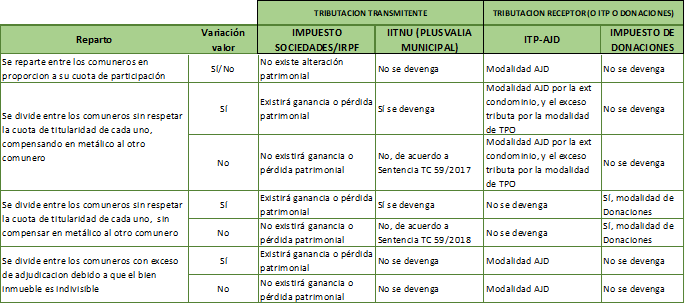
As you can see, the way in which the termination of the co-ownership is carried out is crucial for proper tax planning and to reduce the tax burden as much as possible, and it must be precisely designed which assets are allocated to each co-owner according to their share and what value is given to each asset, taking into account their intended use and the tax burden arising from the transaction
[1] If this was your case, you should know that you can appeal the return already paid and have the excess amount refunded, provided that 4 years have not passed since the date it was filed.